If you’re asking this question, something is already moving in you. Maybe it started with a trip, a conversation, a book, or just this quiet nagging sense that your life is supposed to matter in a way you haven’t fully stepped into yet. I don’t know what brought you here, but I’m glad you’re asking.
My name is Zachary Harrod. I’ve lived and worked in Prague, Czech Republic for over two decades. I first came in 2002, did a nearly two-year internship, and never really left. What you’re about to read is not the polished version of this story. It’s the honest one. The version I wish someone had handed me when I was sitting where you are.
The Question Behind the Question
When most people ask whether missionary work is right for them, they’re really asking something underneath that. Am I the kind of person who could actually do this? Do I have what it takes? And if I’m being really honest, is this a genuine calling or just a feeling I’ll eventually talk myself out of?
Those are worth sitting with. Let me try to answer them from over twenty years of real experience.
Two Moments That Changed Everything
The first happened on a beach in Panama City Beach, Florida during a spring break outreach with a campus ministry, CRU. We had a bit of training, a lot of enthusiasm, and a beach full of coeds who were, let’s say, rather lubricated. What surprised me wasn’t how hard it was. What surprised me was how natural it felt. Honest conversations with people who were searching, people looking for wholeness, for stability, for something real in a world that kept shifting under their feet. So much fun. And going home, something had changed in me.
Something else settled in me that day too, something I couldn’t fully articulate until years later. In Matthew 28, when Jesus gives what we call the great commission, he says, “Go therefore and make disciples of all nations, baptizing them in the name of the Father and of the Son and of the Holy Spirit.” (Matthew 28:19, ESV) You can see three distinct identities in those names. Father, Son, Holy Spirit. Family member. Servant. Sent one, or Missionary. If you claim Jesus, that third identity belongs to you whether you’re in Prague or Peoria. I felt that on the beach before I had words for it.
The second moment came during my first summer in the Czech Republic with Athletes in Action. I kept hearing the same thing from Czech students. I’m Czech. I’m an atheist. Over and over. But as I kept showing up, kept asking questions, kept listening, I started to realize those words weren’t the end of the conversation. They were the beginning of one. One of those conversations contributed to a young woman coming to faith. The following summer she married a man who also followed Jesus. When photos of her baptism came through, I knew I was supposed to come back. I’ve been here ever since.

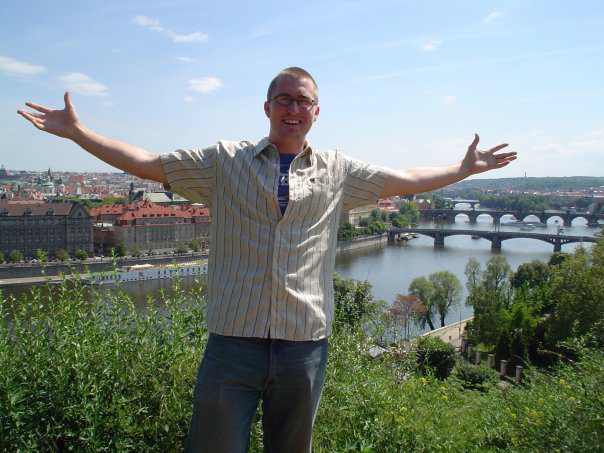
Zachary recreating the CRU “This is Where I Live” campaign in Prague. (2004)
The Biggest Misconception
When people hear my story, they often immediately disqualify themselves. They assume a calling to missions means decades abroad, learning an impossible language, and finding a national spouse. That’s my story. It is not the template.
Missionary work can be a season. One year, two years, five years. God uses seasons powerfully, both in the people you serve and in the person you’re becoming. Some of the most formative work I’ve ever witnessed happened through people who came for two years and went home carrying something they never would have found otherwise.
The other thing I wish someone had told me early: go in as a learner. James writes, “Let every person be quick to hear, slow to speak, slow to anger.” (James 1:19, ESV) Most of us show up ready to talk. The calling is actually to listen first. Jesus, who was God himself, consistently showed up asking questions rather than delivering answers.
Think about the years he spent in Nazareth before his public ministry, somewhere close to twenty years after that moment at the temple at age twelve. Someone once said, and I wish I could remember who, that in those years God was incarnate to Nazareth, but Nazareth was also getting into Jesus. He was learning what it meant to be among the people. That is why Eugene Peterson’s paraphrase of John 1:14 has always stopped me: “The Word became flesh and blood, and moved into the neighborhood.” If the Son of God operated that way, the posture of a learner isn’t optional humility. It’s the actual method. The people you’re going to serve have things to teach you that you cannot get from a training manual.
What Actually Predicts Whether Someone Will Thrive
I’ve watched a lot of people come through Prague. Some have stayed. Many haven’t. Here’s what I’ve noticed separates the two.
Humility is the foundation. Not the performative kind, but the genuine willingness to not have all the answers and be completely okay with that. Tied to it is resilience, what I would just call grit. Things will not go as planned. Regularly. Repeatedly. The people who last are not the ones who never struggle. They’re the ones who can say “Jesus, help me make it through today” and mean it, then get up the next morning and keep going.
Creativity matters more than people expect. When one approach stops working you can’t just throw your hands up. But you also can’t pivot recklessly every time something gets hard. You need to hold the big vision firmly while keeping everything else open handed. That tension requires a kind of faithful creativity that is genuinely rare.
I never thought I had a gift for languages. Turns out I do, though I’m convinced God gave it to me along the way rather than before I arrived. But more than language aptitude, what actually helped me was the posture underneath it. I’m here to learn. I will look foolish sometimes. That is completely fine.
The Difference Between Passionate Faith and Vocational Calling
Here is the clearest test I know. Are you already living as a missionary right where you are?
I’ve met a lot of people with romanticized views of missionary life. Some grew up in the church and always imagined themselves on the field someday. But if you’re not practicing this at home, in your neighborhood, in your workplace, going overseas won’t fix that. The field doesn’t manufacture what wasn’t already there.
What full-time vocational missions does is free you up. It removes the competing demands of another job so you can pour everything into relationships, community, and helping people move toward Jesus.
I had this conversation recently with a young Czech man considering full-time ministry. He told me he felt like accepting financial support would compromise his character, like he needed to prove his motives were pure by not taking money. I understood where he was coming from. I didn’t let it go though.
That posture, however sincere, doesn’t hold up biblically. Jesus himself had people who financially supported his direct ministry. Luke tells us, “Soon afterward he went on through cities and villages, proclaiming and bringing the good news of the kingdom of God. And the twelve were with him, and also some women…who provided for them out of their means.”(Luke 8:1-3, ESV) Jesus was freed up to pursue his calling because others came around him and made that possible. If accepting support compromised character, it compromised Jesus first. That’s not a position anyone should be comfortable holding.
Accepting support for this work is not a character issue. It’s a strategic and biblical decision that makes deeper investment possible. The freedom it creates is the point.
This work has never been his alone. Prague, the Vltava, and the person who made staying make even more sense.
What It Has Actually Cost
I want to be honest here because the romantic version of this story doesn’t prepare anyone for the real thing.
Weddings missed. Funerals missed. This country and these people have been prioritized over friends and family in ways that have sometimes been genuinely painful for the people I love and for me too. If any of those people are reading this: thank you, and I’m sorry. What you’ve given up matters, and it is part of what God is doing here.
The cost cuts deeper personally, and this part rarely gets talked about. You need to be willing to be like John the Baptist. He said it plainly, “He must increase, but I must decrease.” (John 3:30, ESV) You may spend years building something you never fully see come to fruition. You may be the “voice in the wilderness” that someone else builds on. Are you okay with that? Are you okay loving Jesus and staying faithful even if the outcomes you dreamed about don’t arrive on your timeline, or at all?
That’s not a rhetorical question. It’s the actual test.
What Makes Europe and Prague Different
If someone tells me they feel called to Prague or Europe, my first response is usually: are you sure? Not to discourage them, but to make sure they understand what they’re walking into.
Europe is post-Christian in a way that’s different from secular in the American sense. There’s not just an absence of faith here. There’s a long and complicated history with institutional Christianity that left a lot of wounds. Czech people in particular have survived centuries of occupation, manipulation, and broken promises from powerful institutions, including the church. Their skepticism isn’t laziness or apathy. It’s earned.
Prague gets referred to sometimes as a missionary graveyard. I’ve read statistics suggesting the average person who commits to three to five years here makes it about eighteen months. I’ve watched that play out more times than I can count, usually not because people lacked passion but because they arrived with expectations that weren’t grounded in the reality of the culture.
And yet. The Czech people are among the most resilient, creative, and quietly profound people I’ve ever known. Their language and culture have survived everything thrown at them across centuries. If the good news of Jesus takes root here, not as an import but as something genuinely transforming lives from the inside out, I believe it spreads. Prague to the Czech Republic to post-Christian Europe. That’s what gets us out of bed.
But you need grit to work here. You need to love people who aren’t yet sure they want to be loved by someone like you. And you need a long horizon.
Prague at dawn. This city has survived everything thrown at it. That’s exactly why it matters.
How to Actually Test a Calling
Start by praying and reading. Learn about the place. Then go. Not for a week if you can help it, but for a month. A week gives you a romanticized view of almost anywhere. A month starts to wear that off.
The question isn’t whether the romanticized view fades. It always does. The question is what you feel when it does. Do you still want to be there?
Talk to people who know you well. Ask them to pray with you and speak honestly into what they see. Get on a call with a missionary working in the place you feel drawn to. Ask hard questions. Then take a vision trip. And if you’re considering something long-term, don’t make that decision based on two weeks. Give yourself a month or two first.
If you’ve read this far and something in you is still saying yes, that’s worth paying attention to.
If Prague and the Czech Republic are on your heart, Míša and I would genuinely love to hear from you. Not as a recruitment pitch. Just as people who have been around this table for a long time and want to have an honest conversation. Reach out through harrodovi.com and let’s talk.
Zachary Harrod has spent over two decades in the Czech Republic doing the kinds of things that don’t fit neatly into a job title: missionary, coach, church planter, husband to a Czech wife, and someone who has never stopped believing Prague is worth the long haul. He and his wife Míša lead Kolem Stolu, a table-centered movement working toward gospel presence in every neighborhood of Prague.





0 Comments